What actually makes a property “distressed”
Most real estate investors looking for distressed properties start in the same place: Zillow’s foreclosure filter, county auction listings, a few “we buy houses” Facebook groups. They pull the same list everyone else pulls, send the same mailers, and wonder why response rates are non-existent and offers keep getting outbid.
Chasing visible distressed inventory puts you in direct competition with every investor running the same playbook. The better path is to build a system that identifies distress signals before properties hit public channels — then prioritize by likelihood to actually transact.
The term gets thrown around loosely, but distress isn’t a single condition. It’s a spectrum of seller motivation signals — some visible in public records, some buried in data layers most investors never touch.
Financial distress
External pressure forcing a decision. The owner is underwater, behind, or legally cornered — with the foreclosure clock running.
Life-event distress
Zero financial crisis, plenty of motivation to liquidate quickly. Heirs living out of state are a classic example.
Physical distress
Properties that can’t qualify for conventional financing — exactly what cash buyers are equipped to handle.
Situational distress
The owner may not be in crisis — they just want out and will trade price for a simple, fast close.
“My antenna goes off when I see a problem that I can fix. Is there a problem with the property itself? Is there a problem with the situation the seller’s in? If I can solve it by coming in with a quick cash offer, then I have an opportunity and an edge.”
— Doug Greene, Signature Properties (Philadelphia)
That’s the right mental model: you’re not searching for a property type, you’re searching for solvable problems. Financial distress is just one slice. Life events, physical condition, and owner fatigue all drive motivated sellers — often without any formal foreclosure signal at all.
“The properties that don’t qualify for financing don’t do well when they go listed with an agent,” says Greene. Homes with foundation problems or active roof leaks typically can’t attract conventional buyers, but they’re exactly what cash real estate investors are equipped to handle.
Where to find distressed properties
Your sourcing options fall into three buckets. Each has real tradeoffs — the right choice depends on your deal volume goals and how many markets you’re working.
3 distressed property data sources compared
| Source | Cost | Data freshness | Scalability | Contact data | Best for |
|---|---|---|---|---|---|
| County public recordsTax lists, lis pendens, probate court | Free | ✓ Authoritative | ✗ Manual, county-siloed | ✗ Not included | 1–2 zip codes, occasional deals |
| List brokersPre-compiled foreclosure & absentee lists | $0.05–0.30/record | ~ Snapshot in time | ~ Moderate | ~ Sometimes | Quick starts, single-market campaigns |
| Data platformsAggregated records + stackable filters | Monthly subscription | ✓ Continuously updated | ✓ Multi-market | ✓ Bundled skip trace | Volume investors, repeatable pipelines |
County records are free and authoritative — tax delinquency lists, lis pendens filings, probate records. Reviewing court records alongside these can surface foreclosure properties at earlier stages, before they reach public auction. But pulling them is manual, often siloed by county, and you’re assembling fragmented data yourself.
List brokers sell pre-compiled lists of foreclosures, absentee owners, or high-equity candidates. Convenient, but you’re buying a snapshot that ages from the moment you receive it — and you’re competing with everyone else who bought the same list that month.
Data platforms aggregate tax records, mortgage filings, lien data, MLS history, and ownership records into a searchable interface with stackable filters. For investors running volume, the efficiency gains typically justify the cost.
How to choose: Doing 2–3 deals a year in one zip code? Manual county records may be enough. Building a repeatable system across multiple markets? You need infrastructure that lets you filter, verify, and reach motivated sellers without assembling six data sources by hand.
The 5-step distressed property pipeline
Consistent deal flow comes from treating distressed real estate acquisition like pipeline-building, not one-off hunting. Here’s the system that produces repeatable results.
Start with distress signals, not property lists
Most investors search for a property type (“foreclosure properties in Phoenix”) and work backward. Flip it. Layer motivation signals to surface owners likely to sell — regardless of whether they’ve hit a formal foreclosure stage yet.
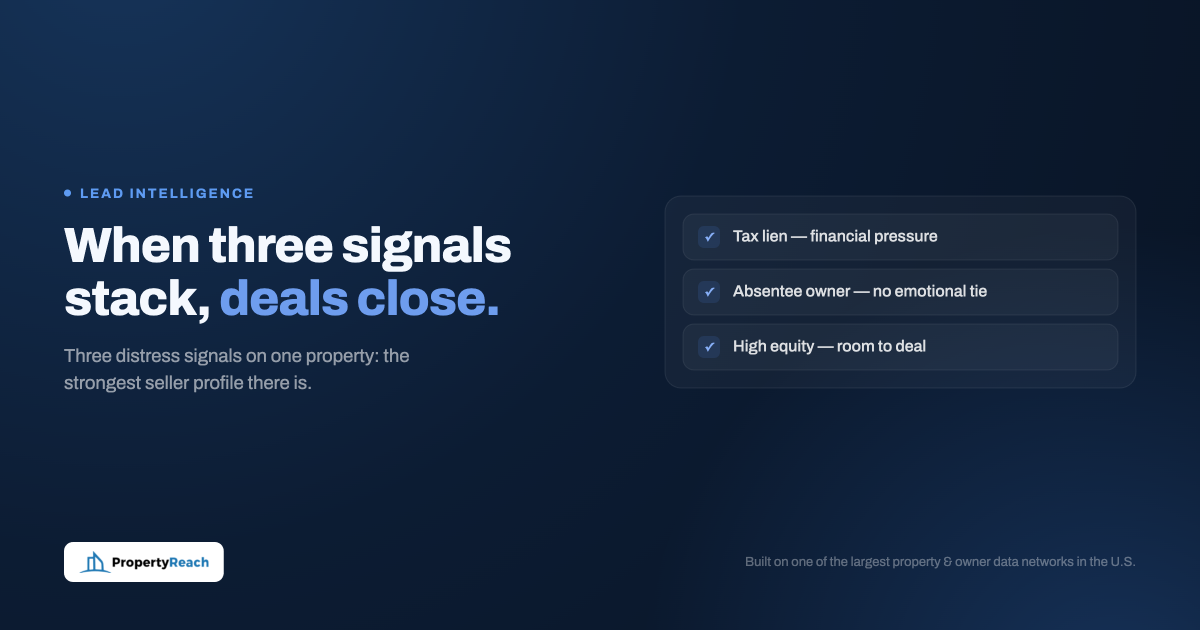
Tax liens combined with high equity suggests an owner who has value to extract and a reason to act. Pre-foreclosure status on an absentee-owned property points to an out-of-state owner unlikely to fight for a house they haven’t lived in for years. Code violations plus long ownership tenure often indicates deferred maintenance by an aging owner underwater on repair costs. Probate plus vacancy usually means heirs who want a clean exit, fast.
Stack filters to narrow your list
Untargeted volume hurts conversion. A list of 5,000 distressed properties produces worse results than 200 high-probability leads built from stacked filters: property type, equity percentage, ownership duration, lien status, occupancy, days since last sale.
Each additional filter compounds targeting accuracy. The goal is a list small enough to work thoroughly — every lead gets real attention — rather than a bloated list you blast and hope for callbacks.
Verify and prioritize before outreach
Data decays. Phone numbers go stale, ownership changes hands, situations resolve. Before spending money on mail or time on calls, run a verification layer: skip tracing with recently validated data, cross-referencing mailing addresses against tax records, and resolving LLC ownership to actual decision-makers. Flag potential title issues at this stage too — a lien you didn’t catch before outreach can derail a deal weeks later.
“You might get a phone call from just one person who’s part of a broader collective decision on selling the house. And if you just take that for what it is, you might find out later not everyone wants to sell.”
— Doug Greene, Signature Properties
Qualify fast and route non-fits
Not every seller who responds is a real opportunity. Some are testing the market. Others have unrealistic price expectations. The sooner you identify them, the less time you burn.
Greene frontloads the price question immediately: “If they answer, ‘Well, I really want what Zillow says,’ my response is, ‘Those are MLS estimates, so you should list it.'” Referring non-fits to an agent keeps the relationship warm and frees your pipeline for leads where you can add value.
“The hidden cost I’ve seen in my business is spending time on leads that are not actually motivated.” — Doug Greene. Qualifying fast is how you protect your pipeline’s unit economics.
Stay consistent for six months minimum
Building a pipeline of off-market properties isn’t a one-month experiment. It takes time for outreach to gain traction, for follow-ups to convert, and for your system to generate predictable deal flow.
“I know people in the real estate business who have made millions of dollars in each of those channels,” Greene says. “I don’t really know if it matters what you’re doing, as long as you’re sticking with it for at least six months.” Direct mail, cold calling, paid ads, organic inbound — all of them work. None of them work in week two.
Current market conditions (2026)
Distressed inventory isn’t static. It fluctuates with interest rate cycles, foreclosure process timelines, employment trends, and regional economic conditions. Understanding where the market stands shapes both opportunity and competition.
The current environment — with mortgage rates elevated and pandemic-era forbearance programs long expired — has pushed more homeowners into distress than the 2021–2022 period. More opportunity than the pandemic years, but nowhere near a flood.
Critically, distress still doesn’t mean “motivated to sell at a discount.” Many underwater owners are holding, hoping for a refinance window or a market recovery. The signal quality of your targeting — layering actual motivation indicators rather than just financial strain — separates productive outreach from wasted spend.
The bottom line: More distressed owners means more raw leads — but also more investors noticing the trend. The edge is stacking motivation signals others miss and reaching owners before they’ve been saturated with mailers. Precision targeting matters more in a competitive market than volume outreach.
Frequently asked questions
A distressed property is one whose owner has significant motivation to sell, often quickly and at a discount. Distress can be financial (tax delinquency, pre-foreclosure, liens), life-event-driven (probate, divorce, inheritance), physical (deferred maintenance, code violations), or situational (tired landlord, failed MLS listing). The key distinction is that the owner has a problem you can solve — not just that the property is cheap or damaged.
The three main sources are county public records (tax delinquency lists, lis pendens filings, probate court), list brokers who sell pre-compiled distressed property lists, and data platforms that aggregate multiple sources with stackable filters and bundled contact data. For investors doing volume across multiple markets, data platforms offer the best targeting precision and workflow efficiency.
Pre-foreclosure begins when a lender files a lis pendens notice after a homeowner misses payments, but before the property is repossessed or sold at auction. The homeowner still owns the property and can sell it — often to avoid the foreclosure process entirely. Foreclosure is the completed legal process where the lender takes ownership. Investors can approach owners in pre-foreclosure directly, with significantly less competition than at the foreclosure auction stage.
Not automatically. A distressed owner doesn’t always mean a motivated seller willing to discount. Many financially stressed owners are holding out for refinancing or a market recovery. The key is layering motivation signals — combining financial distress with absentee ownership, long holding periods, or deferred maintenance — to identify owners most likely to sell at a price that works.
Expect at least six months before a consistent pipeline develops. Outreach takes time to gain traction, follow-up sequences need to mature, and your targeting needs refinement through real data. Investors who abandon a method inside 60 days rarely see results — consistency is the single biggest factor separating investors who close off-market deals from those who don’t.
As many as it takes to get to a list size you can work thoroughly. A targeted list of 200 high-probability leads typically outperforms a broad list of 5,000. Strong stacking combinations: property type + equity range + ownership duration + lien status + occupancy type. Each additional filter compounds targeting accuracy and reduces wasted outreach spend.