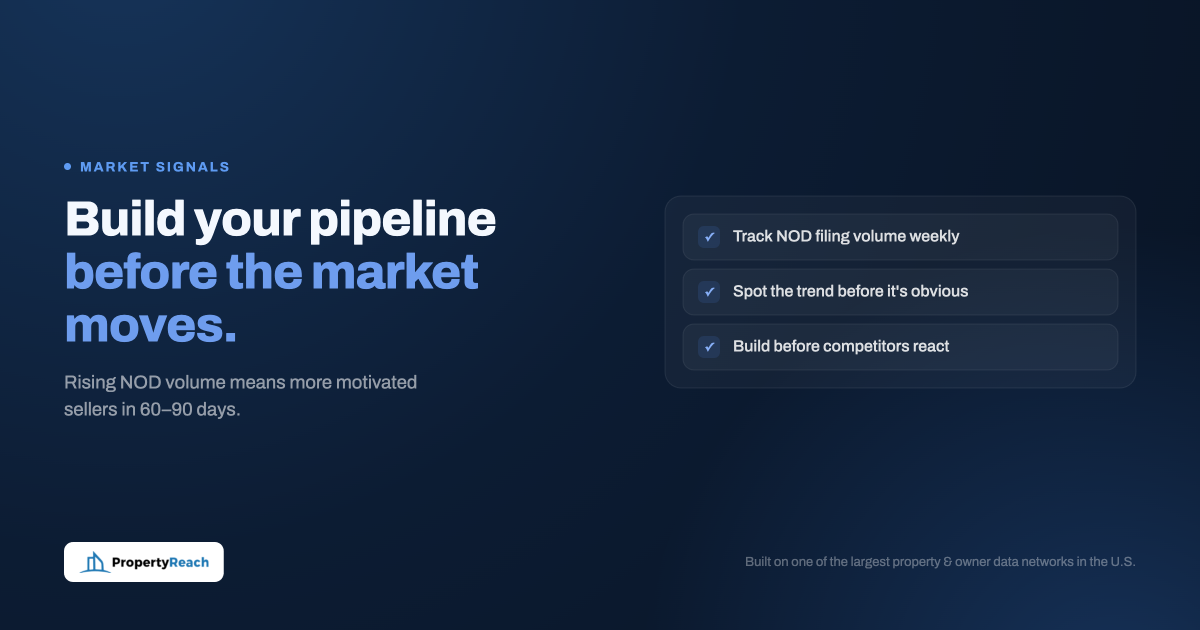
Pre-foreclosure filing volume doesn’t move randomly. It follows market stress cycles — rising when economic pressure builds, falling when conditions ease. Investors who monitor filing trends can anticipate where motivated seller inventory is growing before it becomes obvious to every competitor in the market.
This isn’t about predicting macroeconomic conditions. It’s about tracking a specific leading indicator in your specific target markets and acting on it 60–90 days before the window peaks.
Pre-Foreclosure Filings as a Market Signal
A Notice of Default is a public record. When NOD volume rises in a county or zip code, it means two things: more homeowners are entering the distressed seller pipeline, and more off-market deals will be available in the next 60–90 days.
The investor who acts on that signal today — builds the list, runs skip tracing, starts outreach — is in the prime window when it matters. The investor who only discovers those properties when they appear on a “pre-foreclosure leads” report from a data provider may be reaching out after the window has already peaked.
How to Track Filing Trends in Your Target Markets
Two approaches work: manual county monitoring and data platform trend tracking.
Manual county monitoring: Most county recorder websites publish NOD filings in near real-time. Set up a regular check — weekly or bi-weekly — to compare filing volume against prior months. This is free but labor-intensive across multiple counties.
Data platform trend tracking: Real estate data platforms that aggregate NOD filings across counties can surface volume trends faster. If your platform shows you a month-over-month filing count for your target markets, that’s the metric to watch.
What you’re looking for: a 15–25% increase in filing volume over two or more consecutive months. Single-month spikes can be noise. Sustained increases signal a real trend.
Why Acting Early on Filing Trends Matters
When filing volume rises, investor competition also rises — but with a lag. Most investors react to current conditions, not leading indicators. By the time a market is obviously hot with pre-foreclosure activity, every investor with a basic data subscription is reaching out to the same owners.
Acting on the trend 60–90 days early means:
- Contacting owners in the 31–90 day prime window before they’ve been saturated with investor outreach
- Building relationships with sellers before they’ve become defensive from repeated cold contact
- Closing deals before competition drives up the prices sellers expect
The pre-foreclosure market rewards early movers significantly more than the MLS does. Speed and timing are genuine competitive advantages here.
How to Prepare Your Pipeline Before Filings Peak
When you spot a filing trend building in a target market, three things to do immediately:
Build your list now. Pull all current pre-foreclosure properties in the market with your equity and ownership filters applied. This is your baseline. You’ll add to it weekly as new filings appear.
Pre-run skip tracing. Getting contact data ahead of time means you’re ready to call the day a new filing hits your radar — not three days later after running a batch.
Set up your outreach sequence. If you don’t have a follow-up system in place, a filing volume trend is the forcing function. Get your follow-up sequence built before the pipeline fills up.
Frequently Asked Questions
How often should I check pre-foreclosure filing volume in my target markets?
Weekly is the ideal cadence for active markets. Monthly is acceptable for lower-volume secondary markets where you’re not running active outreach. The more often you check, the earlier you can act on new filings.
Does rising filing volume always mean more deals?
Not automatically. High filing volume combined with low equity in a market means more distressed owners but fewer workable deals. Track filing volume alongside equity distribution in the same market for a complete picture.
What causes pre-foreclosure filings to rise?
Common triggers include rising unemployment in a local economy, interest rate adjustments affecting adjustable-rate mortgages, property value declines reducing equity cushions, and general economic stress affecting borrowers’ ability to service debt.
Monitor Filing Trends. Build Your List Early.
PropertyReach updates pre-foreclosure data weekly so you can track trend shifts and build your pipeline before the window peaks.
Get Started Free