Updated April 17, 2026 · 10 min read · Lead Generation
The wholesalers and flippers closing the most deals in 2026 are not running a single list or a single channel. They stack distress signals in public records to shrink a county down to a few hundred owners, then run a multi-touch cadence across mail, SMS, and phone for ninety days and beyond. Below are the twelve sources that still produce consistently, the filter combinations that separate noise from real motivation, and the outreach rhythm that turns a list into signed contracts.
What “motivated” actually means
A motivated seller is not just an owner who might sell. Motivation has four components, and you need at least three before a lead is worth a full campaign. The owner has a reason to sell now — a life event, a financial squeeze, or a property problem. They have a timeline measured in weeks or a few months, not years. They are willing to trade price for speed or certainty. And they have the authority to sign — no hidden co-owners, tangled estates, or lienholders blocking a close.
The entire lead-generation game is compressing your list to owners who are likely to hit at least three of those four. The twelve strategies below do that in different ways. Some pull from public records, some pull from human networks, and the best operators run four or five in parallel.
The 12 motivated-seller strategies that still work in 2026
1. Absentee owners with high equity
An absentee owner is someone whose mailing address differs from the property address. High equity means they own more than 50 to 60 percent of the property outright. The overlap — an out-of-state landlord who has owned the house for fifteen years and is tired of tenant calls — is one of the most consistent motivated-seller profiles in the country. Pull absentee records from the county assessor, join them to a mortgage-balance estimate, and keep anyone above a 50 percent equity threshold.
2. Pre-foreclosure and Notice of Default filings
When an owner falls behind on payments, most states require a public filing — a Notice of Default, a lis pendens, or a Notice of Trustee Sale. These filings are the clearest “I need to sell now” signal in real estate. The competition is heavy, so speed matters. Most successful operators pull new filings weekly and start mail and SMS within 72 hours.
3. Tax-delinquent properties
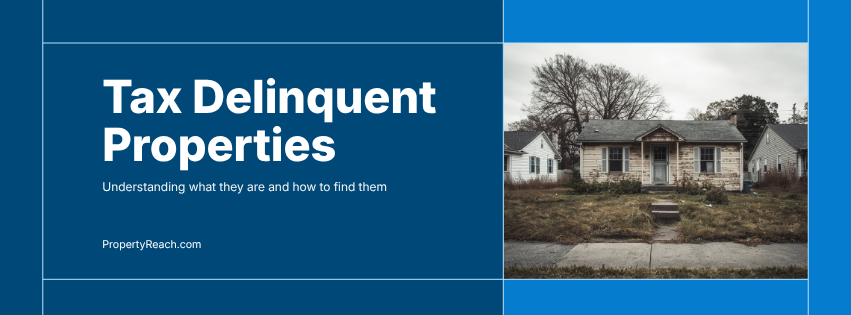
Owners who have not paid property taxes for one or more years are signaling either financial stress or disengagement from the asset. The county treasurer publishes these lists, usually once a year. A property two or three years delinquent with a non-owner-occupied address is a textbook motivated seller. We cover this in depth in Tax Delinquent Properties: What They Are and How to Find Them.
4. Probate and inherited property
When a property owner passes away, the home often becomes an inherited burden for heirs who live elsewhere, have no use for it, and want to split proceeds. Probate filings are public at the county court level. Pair probate records with absentee status and you have a list that converts dramatically above average — often with owners who will accept below-market offers just to resolve the estate.
5. Code violations and condemned properties
Cities publish code-violation records for nuisance issues, unsafe structures, and failed inspections. An owner with three active violations and $8,000 in fines is usually motivated to transfer the problem. Pull these from city code-enforcement portals and match to ownership records.
6. Expired and withdrawn MLS listings
A listing that sat on the market for 120 days and expired without a sale is often an owner who priced too high and then gave up. Six to twelve weeks after expiration, many of them are willing to talk to a cash buyer at a lower number. Pull expireds weekly from your MLS and cross-reference with ownership records for mailing and phone.
7. Tired landlords
Long-term rental owners — held ten-plus years, single property, out-of-state mailing address — are one of the highest-converting sub-segments in real estate. They have equity, they are exhausted by tenant turnover, and they do not want the tax hit of a traditional sale without an exit plan. A conversational approach that leads with “are you tired of managing this from out of state?” out-converts generic cash-offer mail by a factor of three to five.
8. Vacant properties
Vacancy is detectable through USPS vacancy flags, utility shutoffs, and on-the-ground evidence like overgrown lawns and piled mail. A vacant property is costing the owner money every month it sits empty, which is why vacant-plus-absentee-plus-high-equity is probably the single highest-converting three-filter stack in the business.
9. Divorce filings
Divorce is one of the most reliable forced-sale events. Court filings are public in most jurisdictions, though retrieval is uneven across counties. The window is narrow — owners are typically motivated for 60 to 120 days after filing — but conversion is high because the property must be sold or refinanced to complete the settlement.
10. Driving for dollars
Physical distress — peeling paint, boarded windows, dead lawns, a roof the insurance company would not cover — is invisible to every data pull you will ever run. Driving your target neighborhoods and flagging distressed exteriors is still the single best way to find deals that have zero competition. Apps make this scalable: drive the route, tap the phone, and the address goes into a mail queue automatically.
11. Bandit signs and local marketing
“We buy houses” signs on busy intersections produce inbound leads that are, by definition, more motivated than any list — they called you. Check municipal rules; some cities fine aggressively. Direct-response postcards to a zip code also produce inbound and are legally safer.
12. Referral networks with attorneys and estate planners
Probate attorneys, estate-sale companies, bankruptcy attorneys, divorce attorneys, and senior-move managers all work with people who need to liquidate real estate on a deadline. A handful of good referral relationships will produce five to ten deals a year with effectively zero lead cost. The catch is the ramp — it takes six to nine months of relationship building before referrals flow consistently.
Stack filters to find the top five percent of a county
Any one of the lists above will work. The wholesalers who close fifty-plus deals a year rarely run any single list in isolation. They stack two or more signals to get leads where the probability of a quick sale is meaningfully higher. The table below shows how stacking compresses a typical mid-size county.
| Filter Stack | Typical County Count | Motivation Density | Best Use |
|---|---|---|---|
| All single-family homes | 40,000 | Baseline (~1%) | Never mail this raw |
| Absentee owners | 8,500 | 2–3x baseline | Broad acquisition campaigns |
| Absentee + 50%+ equity | 3,200 | 4–5x | Scalable direct mail at volume |
| Absentee + equity + tax delinquent | 450 | 8–12x | Phone and SMS outreach |
| Absentee + equity + vacant | 180 | 10–15x | Aggressive multi-touch cadence |
| Pre-foreclosure + 50%+ equity | 90 | 15–25x | Door knock and same-week follow-up |
The shift from 40,000 records to 180 is not a small optimization — it is the difference between burning $25,000 on mail that goes nowhere and running a targeted $2,500 campaign that produces three to five contracts. PropertyReach was built specifically to let investors stack these filters in one interface across nationwide public-records data.
A 90-day outreach cadence that actually gets replies
Once you have a tight list, outreach determines everything. A single postcard drop is a rounding error — industry benchmark is 0.5 to 1.0 percent response, and most of those responses are not real sellers. A real cadence looks like this.
Days 1–7: Open the channel
- Day 1: First direct-mail piece — a yellow letter or handwritten-style postcard. Keep it short, specific, and addressed by name.
- Day 3: First SMS (only to TCPA-scrubbed numbers with prior relationship consent where required). One sentence: “Hi [Name], this is [You] with [Company] — are you open to an offer on [Address]?”
- Day 5: First cold call. Same script. Log the outcome.
Days 8–30: Stay present
- Day 14: Second mail piece, different format (letter after postcard, or vice versa).
- Day 21: Second call attempt at a different time of day.
- Day 28: Ringless voicemail with a friendly, non-salesy tone.
Days 31–90: Separate the signal
- Day 45: Third mail piece, usually a contrast piece — “We have tried to reach you” or a simple photo postcard of a recent close.
- Day 60: Third call. By now, everyone still unresponsive is either not home or not interested; your response rate on this call is usually your highest.
- Day 90: Fourth mail. Evaluate the list — pull anyone who has engaged into active follow-up and move the rest into a long-term monthly nurture.
The four questions that qualify every live conversation
When a seller finally picks up, you have maybe ninety seconds before they decide whether to keep talking. Do not pitch. Ask four questions, in this order, and listen.
- Condition: “Tell me about the house — how would you rate it on a scale of one to ten?” You are listening for honesty and specifics. “Seven” with no detail means they have not thought about it. “Four, the roof leaks and the furnace is original” means they are in reality.
- Timeline: “If we could work something out, when would you want to close?” Under 60 days is strong motivation. Six-plus months is a maybe.
- Motivation: “What is making you think about selling?” Silence is okay. Let them answer in their own words. The answer is almost always one of the twelve triggers above.
- Price: Last. “What number were you hoping to get?” You are not negotiating yet — you are finding out whether their expectation is within a workable range.
Follow-up is where most of your deals actually close
Industry data consistently shows that deals close between touch five and touch twelve. Most operators stop at touch two or three. The owners who said “not right now” in month one are the ones you will buy from in month five, month eight, or month fourteen. Put every qualified-but-not-closed lead into a monthly touch — one mail piece, one SMS if consent is on file, one call per quarter — and keep it running for a full year. This is where the deal pipeline multiplies.
Ready to run this on real data?
PropertyReach gives you nationwide public-records coverage, stacked distress filters, built-in skip tracing, and unlimited exports — in one platform, for less than most wholesalers spend on single-source list pulls.
Frequently asked questions
What is a motivated seller?
A property owner who needs to sell quickly and is willing to trade price for speed or certainty. Common triggers include divorce, probate, job relocation, tax delinquency, pre-foreclosure, landlord burnout, inherited property, or repair costs they cannot cover.
What is the best list to find motivated sellers?
There is no single best list. The highest-converting lists are stacked lists — two or more distress signals combined, like absentee plus high equity plus tax-delinquent. Stacking compresses a 40,000-record county to a few hundred high-probability owners.
How do I find motivated sellers with no money?
Driving for dollars, door knocking, free Craigslist and Facebook Marketplace posts, and networking with probate attorneys, estate-sale companies, and local property managers all cost zero dollars. The tradeoff is time — expect 30 to 60 hours per deal when you start with sweat instead of data.
How many touches does it take to get a response?
Five to twelve touches across channels before the first response is the industry norm. Single-touch direct mail converts at 0.5 to 1.0 percent. Adding SMS and cold calls to the same list typically triples the response rate.
Is cold calling motivated sellers legal?
In most U.S. states, business-to-consumer cold calls are legal if you scrub against the federal Do Not Call list and any applicable state lists. SMS is more tightly regulated under the TCPA. Always consult an attorney in your state before running a large outbound campaign.
What is the difference between a lead and a motivated seller?
A lead is any owner on a list who might sell. A motivated seller is an owner who has told you — in words — that they want to sell, why, and within a time frame. Most of your list is leads. Only 5 to 10 percent of responses will be motivated sellers.
How long until my first deal?
From first mail drop to signed contract, expect 30 to 90 days for your fastest deals. First deals from a cold list usually take 90 to 180 days. Consistent, multi-channel cadence is what compresses that timeline.
Keep going
Once you have the list and the cadence, the next questions are about process and scale. These companions walk through the adjacent pieces: