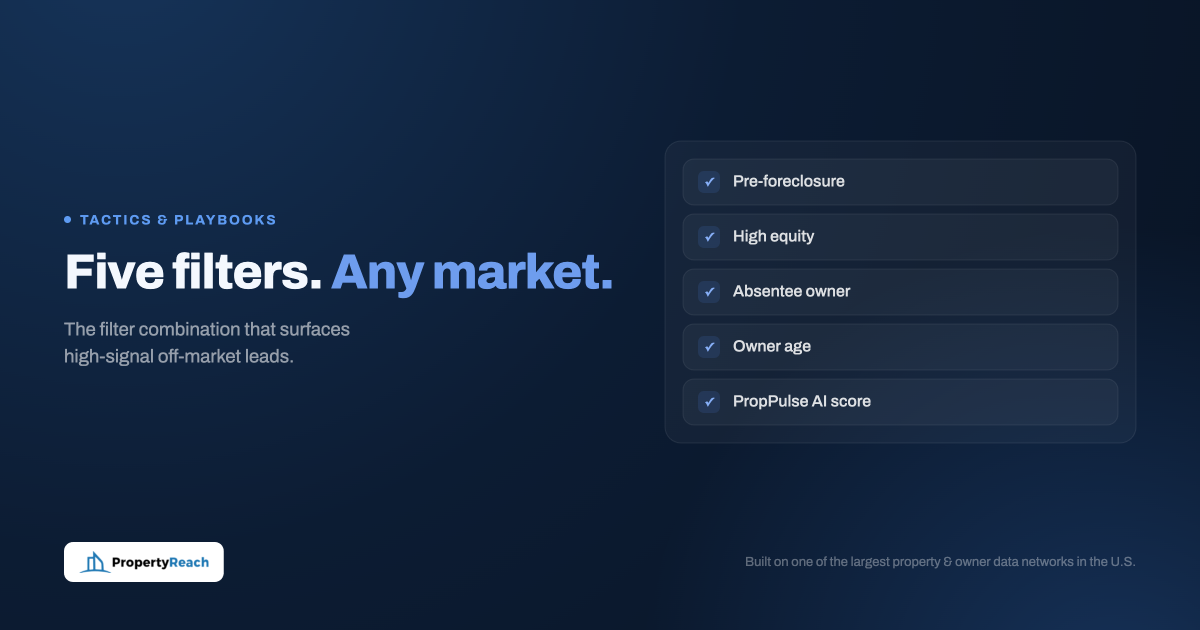
If you were starting fresh in a new market tomorrow with a specific acquisition goal — say, finding off-market single-family deals at 65–70 cents on the dollar — here’s the exact filter stack to use in PropertyReach.
This isn’t a theoretical framework. It’s a practical sequence based on what actually produces workable deal pipelines across different markets.
The 5-Filter Stack
Filter 1: Pre-Foreclosure Status
Setting: NOD filed within the last 60 days
Pre-foreclosure is your strongest single distress signal. An active NOD means a legal process has started, creating a real timeline the owner cannot ignore. Filtering to the last 60 days puts you in the prime outreach window — past the denial phase, before auction proximity makes a traditional close difficult.
Filter 2: Equity Position — Minimum 35%
Setting: Estimated equity ≥ 35%
This is your deal viability filter. Below 35%, the math rarely works for a cash acquisition at a meaningful discount. At 35–50%, deals are possible. Above 50%, you have real room to work. Set your minimum based on your acquisition criteria; 35% is a reasonable floor for most off-market strategies.
Filter 3: Absentee Owner
Setting: Absentee = Yes
Absentee owners treat the property as an asset, not a home. They respond faster to practical conversations, move to decisions more quickly, and have lower emotional barriers to selling below full market value. Combined with a distress flag, this significantly improves your contact-to-conversation rate.
Filter 4: Owner Age — 55 and Older
Setting: Owner age ≥ 55
This filter narrows the list further by probability of lifestyle-driven motivation. Owners 55 and older are more frequently in positions where simplifying finances, moving closer to family, or exiting a property management burden creates genuine openness to selling. This isn’t a rule — it’s a probability filter. It removes a portion of the list most likely to be long-term holders with no near-term motivation.
Filter 5: PropPulse AI Score — 65 or Above
Setting: PropPulse score ≥ 65
PropPulse weighs the combination of all the above signals and adds model-level pattern recognition across additional data points. A score of 65+ means the platform’s predictive model agrees with your manual filter stack — the signals it’s seeing indicate above-average conversion likelihood. This is your final concentration layer.
Why Starting Narrow Closes More Deals
Five filters applied simultaneously will produce a short list — typically 100 to 250 properties in most metro markets, fewer in rural ones. That’s not a problem. That’s the point.
Investors who work 200 high-signal leads with full outreach effort — phone waterfall, follow-up sequence, personalized direct mail — consistently outperform investors working 2,000 undifferentiated leads with the same total budget.
The math is straightforward: a 3% contact-to-close rate on 200 quality leads produces six deals. A 0.3% contact-to-close rate on 2,000 generic leads produces six deals too — but at 10 times the outreach cost, three times the burnout, and none of the learning that comes from working high-quality leads carefully.
How to Apply Each Filter
In PropertyReach, apply filters in this order to see how the list narrows at each step:
- Start with your target geography (county, city, or zip code range)
- Add property type (single-family, or your target type)
- Apply the pre-foreclosure filter with 60-day date range
- Set equity minimum to 35%
- Check the absentee owner box
- Set owner age to 55+
- Sort by PropPulse score descending
- Apply PropPulse minimum of 65
Your result is your working list. Export it, run skip tracing, and start outreach from the top — highest PropPulse score first.
Adjusting the Stack for Your Market
This exact stack works best in mid-size metros with active pre-foreclosure activity. In some markets or time periods, adjustments are worth considering:
If the pre-foreclosure list is too small
Expand the date range to 90 days, or add tax delinquency as an additional distress filter. Tax delinquency produces a different seller profile but still generates genuine distress signals.
If you want a larger working list
Remove the owner age filter first — it’s the softest probability filter in the stack. The list will grow, and average signal quality will drop slightly, but you’ll have more properties to work.
If you’re in a rural market
Reduce the PropPulse minimum to 50, and consider removing the absentee filter. Rural markets have different ownership dynamics — more long-term occupants with high equity and fewer absentee investors.
If you work creative financing strategies
Reduce the equity minimum to 20–25%. Subject-to deals and seller financing structures can work at lower equity levels where cash acquisitions can’t.
What to Do With Your Results
Once you have your filtered list:
- Run skip tracing on the full list to get current contact information
- Sort by PropPulse score and work top-to-bottom
- Start with phone on your top 20–30 leads before pivoting to broader outreach
- Build a follow-up sequence for non-responders — four touches over 60 days
- Track everything — contact attempts, conversations, status — so you can follow up systematically
The filter stack is only as good as the outreach system behind it. A great list with no follow-up produces the same result as a bad list with great follow-up: not enough deals. The combination of both is what moves the number.
Frequently Asked Questions
How many leads should this filter stack typically return?
In an active metro market, expect 100–300 results. Smaller markets or rural areas may return fewer. If you’re getting more than 500, consider tightening the equity minimum or raising the PropPulse floor. If you’re getting under 50, loosen the owner age filter or expand the NOD date range.
What if there are very few pre-foreclosure filings in my market right now?
Substitute tax delinquency as your primary distress filter, and keep the rest of the stack the same. In markets with low foreclosure activity, tax delinquency often captures a similar motivated seller profile.
Should I run this filter stack on a weekly basis?
Yes. Pre-foreclosure filings are continuous — new NODs are recorded weekly. Running your filter stack weekly ensures you catch new filings in the prime outreach window rather than months after they’ve been filed and contacted by every other investor in the market.
Is the owner age filter based on public records?
Owner age estimates in real estate databases are typically derived from public records, voter registration data, and other aggregated sources. Like equity estimates, they should be treated as probability filters rather than precise data points.
Build This Exact Filter Stack in PropertyReach
Pre-foreclosure, equity, absentee, owner age, and PropPulse AI score — all available as filters in a single PropertyReach search. Build your list, run skip tracing, start outreach.
Get Started Free