The real estate data industry has historically measured success in the wrong currency. The conversation is always about records — how many properties in the database, how many states covered, how many filters available.
Records are the input. Deals are the output. And the gap between the two is where most investor budgets disappear.
This is the question we built PropertyReach around: not “how many leads can we give you?” but “how many of those leads will actually close?”
Why Outcomes Are the Right Metric
Every element of a real estate data platform should be evaluated against a single question: does this help investors close deals?
A large database is valuable if the data is current and the filtering is good enough to surface properties where deals are possible. It’s not valuable if it’s mostly noise that requires hours of sorting to find the real opportunities.
Skip tracing is valuable if it returns working contact information for the people you actually need to reach. It’s not valuable if the hit rate is low and the numbers go to voicemails or disconnected lines.
Lead scoring is valuable if it predicts which leads convert and which don’t. It’s not valuable if it’s based on simple rule-sets that any investor could replicate manually.
Every feature, every data point, every tool should be evaluated against: does this produce more closed deals per dollar and per hour spent?
What an Outcome-Focused Platform Actually Looks Like
Three characteristics separate platforms that help investors close deals from ones that help investors feel busy:
Data quality over data volume. A pre-foreclosure property with a current filing date, verified equity estimate, and fresh skip trace contact data is worth more than twenty properties with stale information. Outcome-focused platforms optimize for accuracy and recency, not record count.
Workflow integration. Every step in the process from “found a lead” to “contacted an owner” is a potential dropout point. Platforms that require exporting to skip trace, then importing to a mail service, then logging in a CRM lose investors at every handoff. Integrated workflow reduces friction and means more outreach actually happens.
Predictive scoring, not just data surfacing. Showing you all the pre-foreclosure properties in a county is data surfacing. Telling you which ones are most likely to convert based on a combination of signals is prediction. PropPulse AI is built for the second — because the first only solves half the problem.
Closing Rate vs. List Size: The Measurement Shift That Changes Everything
When investors measure their results by list size — “I built a 5,000-contact list this month” — they’re measuring the input. The output is the closing rate: what percentage of those 5,000 contacts turned into a deal.
The measurement shift that actually improves outcomes: track your contact-to-conversation rate and your conversation-to-close rate, not your list size. Then optimize for those rates — which means improving data quality, not buying more records.
An investor closing 6 deals from 300 targeted leads is running a more efficient operation than one closing 6 deals from 5,000 generic ones — even if the total deal count is the same. The first investor has room to scale. The second has a data quality problem disguised as a volume problem.
How to Build a Workflow Built Around Outcomes
Five practical changes that move results from input-focused to outcome-focused:
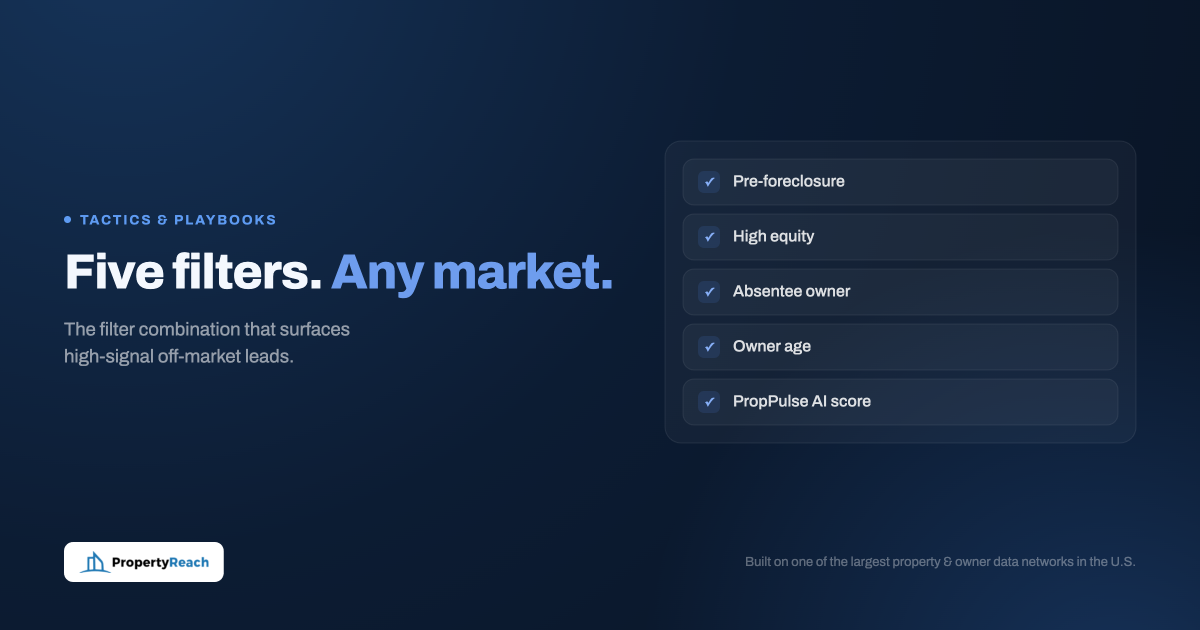
- Set a minimum equity threshold — Remove leads where the deal math can’t work before you spend outreach effort on them
- Require at least one active distress signal — Absentee owner alone isn’t enough; you need urgency, not just circumstance
- Use PropPulse score as a sort order — Work your list from highest score to lowest, not from newest filing to oldest
- Re-run skip tracing before each outreach cycle — Contact data degrades; fresh data on your priority leads every 60–90 days
- Track conversion rates, not just list size — What percentage of your outreach leads to a conversation? What percentage of conversations leads to an offer? Those are the numbers that tell you whether your system is working
Frequently Asked Questions
What is a good contact-to-deal conversion rate for off-market investing?
This varies significantly by strategy, market, and lead quality. Wholesale investors working filtered pre-foreclosure lists typically see 0.5–2% of contacts become deals. Fix-and-flip investors with tighter acquisition criteria often see lower contact volume but similar or higher close rates. Track your own baseline and improve from there rather than optimizing against industry averages.
Does PropertyReach have a larger or smaller database than other platforms?
We focus on data quality and freshness over raw record count. We cover all 50 states with active pre-foreclosure, tax delinquency, and absentee owner data. Our emphasis is on current distress signals and accurate contact data rather than maximizing total records.
How does PropPulse AI scoring actually help close deals?
By concentrating your outreach on the properties with the highest conversion likelihood. When you work a 200-property list sorted by PropPulse score from top to bottom, your best leads get your best effort first — not whoever happens to be at the top of an alphabetical export.
A Platform Built for Closing Deals, Not Building Lists
PropPulse AI scoring, integrated skip tracing, direct mail launch, and equity-filtered search — everything in PropertyReach is built around the question: does this help you close?
Get Started Free