Direct mail gets dismissed a lot in real estate investing circles — usually by investors who have tried it without a targeted list and concluded the whole channel doesn’t work.
The channel works. The issue is almost always the list, not the piece.
Investors closing off-market deals consistently with direct mail are doing a handful of specific things differently. This guide covers what they are.
What Works and What Doesn’t
Most direct mail fails for one of two reasons: it goes to the wrong people, or it looks like the mass mail it is.
What doesn’t work
- Generic “We Buy Houses” postcards mailed to entire zip codes
- Yellow letters printed on a laser printer and mass-folded — owners can tell
- Envelopes with investor branding or a return address that signals bulk mail
- One-shot campaigns with no follow-up sequence
- Mailing to undifferentiated lists with no distress or equity filter
What works
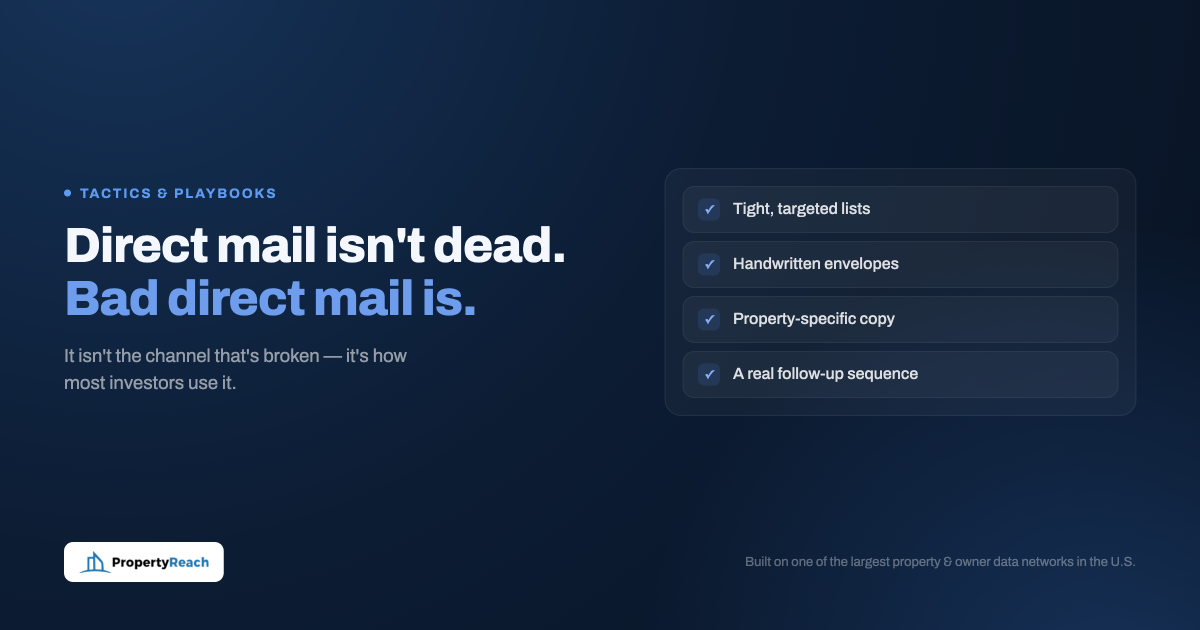
- Handwritten or handwritten-style envelopes — open rates are dramatically higher
- Property-specific letters that reference the exact address in the first line
- Short, plain-language copy with a single low-pressure ask
- A consistent follow-up sequence (not a single blast)
- Mailing to filtered, high-signal lists rather than broad geographic sweeps
Letter vs. Postcard: Which to Use
For motivated seller outreach, a letter almost always outperforms a postcard — especially in later stages of a follow-up sequence.
Postcards have one advantage: they’re visible without being opened. That means no barrier to glancing at the message. But that same visibility makes them feel like advertising, which most people discard without reading carefully.
A letter in an envelope requires more action from the recipient — they have to open it. That’s actually an advantage once they’ve decided to do so, because the open signals enough interest to engage with the content. A well-written letter has space to establish credibility, reference the specific situation, and make a real ask.
Use postcards for early awareness touchpoints in your sequence. Use letters for targeted, high-priority leads where you want a real conversation.
Targeting: Why the List Matters More Than the Piece
No direct mail piece — no matter how well written — converts recipients who have no motivation to sell. Targeting is the highest-leverage variable in direct mail performance.
The most effective direct mail lists for off-market investing share a few characteristics:
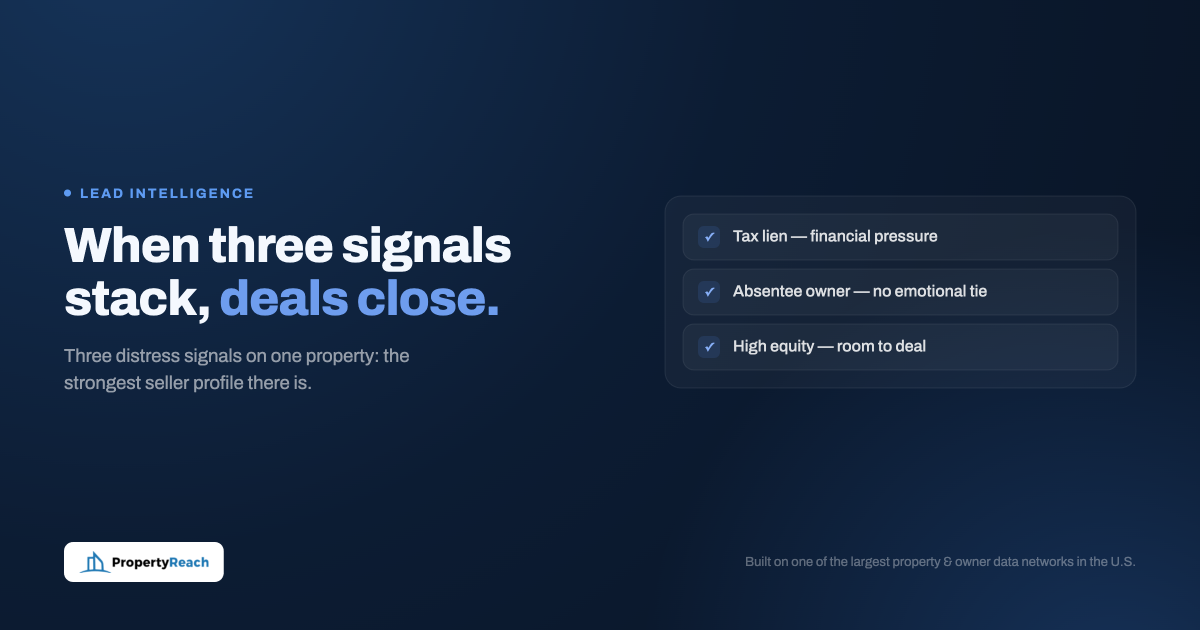
- Active distress signal: Pre-foreclosure, tax delinquency, probate, or another documented trigger
- Meaningful equity: At least 35–40% estimated equity so a below-market offer can work for both parties
- Absentee or non-primary-residence ownership: Owners with less emotional attachment to the property are more likely to respond to an off-market offer
- Filtering to exclude obvious non-starters: Owners currently listed on MLS, properties in active litigation, recent sales
A mailing to 200 filtered, high-signal leads outperforms a mailing to 2,000 broadly defined leads. The response rate is higher, the conversations are better, and the cost per deal drops substantially.
The Follow-Up Sequence
Most motivated seller responses from direct mail don’t come on the first piece. They come on the third or fourth — when the owner has seen enough to believe you’re a real, consistent presence rather than a one-time blast.
A basic sequence for high-priority leads:
- Touch 1 (Day 0): Handwritten-style envelope, short letter, low-pressure ask
- Touch 2 (Day 14): Second letter, slightly different angle — market context or a “still interested” message
- Touch 3 (Day 35): Postcard or letter — shorter, more direct: “I know your situation may have changed — I’m still interested if it’s ever useful”
- Touch 4 (Day 60): Final touch — brief, no pressure: “Wrapping up my outreach but wanted to leave the door open”
A “no” on Touch 1 often becomes a “let’s talk” on Touch 3. Sellers who weren’t ready in January sometimes call in March. The sequence keeps you in position for that shift.
Measuring Direct Mail Performance
Direct mail has a longer feedback loop than digital channels — you won’t know in 48 hours whether it’s working. Track these metrics to evaluate performance:
| Metric | What to Track | Benchmark to Target |
|---|---|---|
| Response rate | Calls/texts received per 100 pieces mailed | 2–5% on targeted lists; 0.5–1% on broader lists |
| Conversation rate | Responses that become real conversations | 50–70% of responses |
| Contract rate | Conversations that produce a signed contract | Varies widely; 5–15% on good lists |
| Cost per deal | Total mail spend divided by closed deals | Dependent on market; track trend over time |
Measure at the campaign level and at the list quality level. A high-equity, pre-foreclosure filtered list will consistently outperform a generic absentee owner list. Track them separately so you know where your budget is working.
Frequently Asked Questions
How much does real estate direct mail cost?
Costs vary by volume, format, and provider. A standard letter-and-envelope campaign with a direct mail service typically runs $0.75 to $1.50 per piece including printing and postage. At scale, costs can come down. For high-priority leads, the per-piece cost matters less than the quality of the list.
Should I use a handwritten yellow letter?
The original handwritten yellow letter worked because it was genuinely unexpected and personal. Today, most investors recognize the format — it’s been mass-produced long enough that the surprise factor is largely gone. Handwritten-font or actually handwritten envelopes still help. The letter inside should be short, specific, and not feel like a template.
How long does it take for direct mail to produce results?
Most responses from a direct mail campaign arrive within 3–6 weeks of the mail drop. Campaigns with follow-up sequences will see responses trickle in over 60–90 days. Don’t evaluate a campaign’s performance before the 30-day mark.
Can I use PropertyReach to launch direct mail campaigns?
Yes. PropertyReach includes a direct mail feature that lets you build your filtered lead list and launch a campaign from inside the platform — without exporting to a third-party mail service.
How many times should I mail the same address before stopping?
Three to four touches is a common standard for motivated seller campaigns. Beyond that, you’re likely spending more than the incremental response rate justifies. For your very highest-priority leads, a fifth touch every 60–90 days is reasonable — sellers’ circumstances change over time.
Build Targeted Direct Mail Lists in PropertyReach
Filter by equity, distress signals, and ownership type. Launch direct mail campaigns from inside the platform — no third-party exports required.
Get Started Free