The best real estate investors aren’t just better negotiators. They walk into each call already knowing enough about the situation to ask the right questions — and that starts with knowing whether you’re calling someone’s home or someone’s investment property.
Owner-occupants and absentee owners are motivated by different things, respond to different openers, and need different kinds of help. Treating them the same is one of the fastest ways to lose a conversation that had potential.
The Core Difference
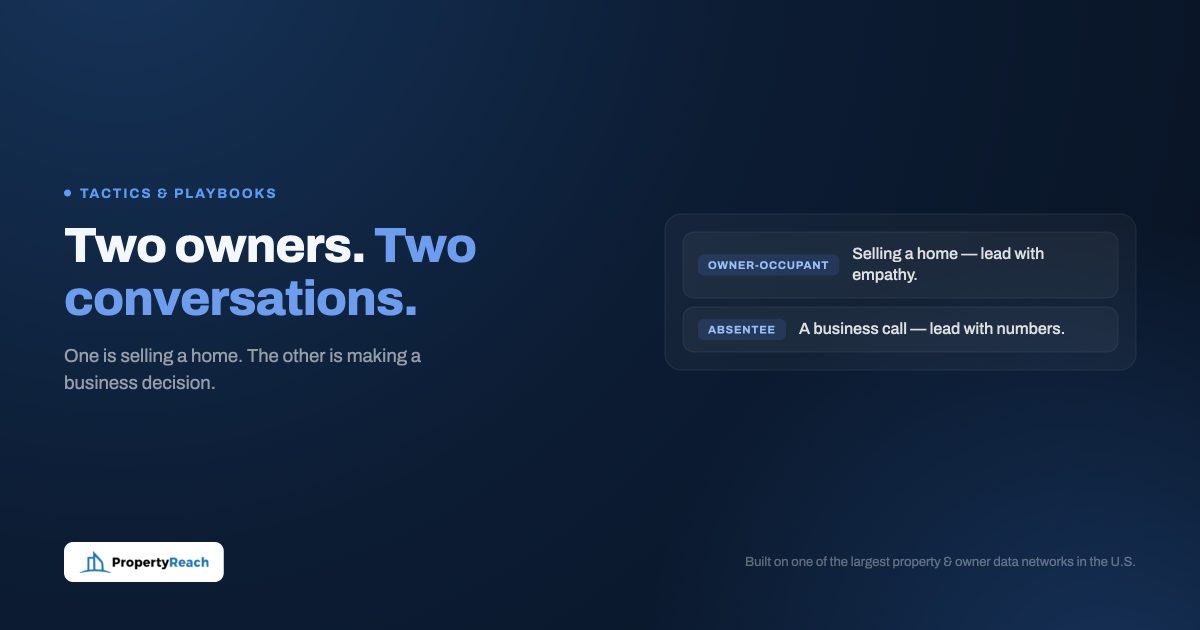
Owner-occupants live in the property. This is their home — where they raised kids, lived through difficult periods, built memories. A conversation about selling isn’t just a financial transaction. It’s a conversation about their life. Jumping to numbers before they’ve been heard often kills deals that could have closed.
Absentee owners own the property as an asset. They live somewhere else — across town, across the country, sometimes internationally. The property is a line item: rental income, carrying costs, appreciation potential, management headaches. They’re not emotionally attached to it the way an occupant is. They’re evaluating whether it makes sense to hold it or let it go.
That’s a fundamentally different mindset, and the conversation should reflect it.
Calling Owner-Occupants: What Works
Start with empathy, not urgency
If an owner-occupant is in pre-foreclosure or facing financial distress, they already know something is wrong. They’ve probably been dealing with it for weeks or months. Coming in with a tone of urgency — “you need to act fast” — often triggers defensiveness rather than openness.
Acknowledgment works better. Not false empathy, but a genuine recognition that this is a difficult situation: “I know this kind of thing is really stressful. I just wanted to reach out in case a conversation would be helpful.”
Ask questions before making an offer
Most owner-occupants don’t respond well to a cold offer. They need to talk first. Questions like “What’s your situation looking like right now?” or “What would be most helpful for you?” give the owner a chance to share context — and that context tells you everything about how to frame an offer if one is appropriate.
Be patient with the timeline
Owner-occupants often need more time to decide than absentee owners. They may need to consult family members, think through logistics, or simply process. Pushing for a fast decision typically backfires. Give them room to move at their own pace — but stay in follow-up contact so you’re there when they’re ready.
Calling Absentee Owners: What Works
Lead with the practical angle
Absentee owners are thinking about the property in terms of what it costs and what it produces. You can move to the practical conversation faster than you can with an owner-occupant. An opening like “I invest in properties in [City] and noticed you own [Address] — I wanted to see if you’d ever thought about your options” is reasonable, not aggressive.
Speak to the carrying cost and management reality
Out-of-state owners managing a property at a distance deal with a specific set of headaches: tenant management, maintenance coordination, property taxes, and the general overhead of owning something you can’t easily check on. If those headaches have accumulated, a clean exit at a fair price often sounds better than continuing to manage from afar.
Referencing those realities — without being presumptuous — can help: “I know managing a property from out of state can come with its own challenges.”
Move to specifics faster
Once an absentee owner signals interest, you can get to numbers faster. They’re not making a decision about their home. They’re making a business decision, and they generally appreciate directness once interest is established.
| Dimension | Owner-Occupant | Absentee Owner |
|---|---|---|
| Primary motivation | Emotional + financial relief | Financial optimization |
| Decision speed | Slower — needs time | Faster — more business-like |
| Best opener | Empathy-first, low pressure | Practical, direct introduction |
| What resonates | Being heard; alternatives explained | Clean exit; no more management headaches |
| Timeline expectation | May need multiple conversations | Can often move quickly once interested |
How to Read the Situation Before You Dial
Knowing the owner type before you call changes the entire approach. Before picking up the phone, check:
- Occupancy flag in your data: Most real estate data platforms flag owner-occupant vs. absentee directly. This should always be part of your pre-call prep.
- Mailing address vs. property address: If the mailing address on record is different from the property address, you’re likely dealing with an absentee owner.
- Length of ownership: Long-term owners (10+ years) have more emotional history with the property regardless of occupancy status. Factor that in.
- Any prior listing history: An owner who listed on MLS and withdrew may have already thought through the “do I want to sell” question and just didn’t like the terms they got.
Openers That Work for Each Profile
Owner-Occupant Opener
“Hi, is this [Name]? My name is [Name] — I’m a real estate investor based in [City]. I came across your property at [Address] and just wanted to reach out in case a conversation would ever be helpful. I know things can get complicated sometimes. No pressure at all — just wanted to introduce myself.”
Notice: no urgency, no immediate offer, no asking about the situation right out of the gate. Just a low-stakes introduction that gives the owner control of whether to engage.
Absentee Owner Opener
“Hi, is this [Name]? My name is [Name] — I invest in properties in [City] and I came across your property at [Address]. I buy off-market — no agents, straightforward process. I just wanted to see if you’d ever given any thought to your options with it. Happy to chat if it’s ever relevant.”
Notice: more direct, references the practical angle (no agents, straightforward), and leaves the door open without being pushy.
Frequently Asked Questions
Which seller type closes more deals — owner-occupants or absentee owners?
Absentee owners generally have higher response rates and faster decision timelines because they’re treating the property as an asset rather than a home. However, owner-occupants with genuine distress and meaningful equity can produce the highest-value deals when approached correctly. Both are worth pursuing with the right strategy.
How do I know if an owner actually lives in the property?
The most reliable indicator is whether the owner’s mailing address matches the property address. Additional signals include homestead exemption status (available in county records) and the name on utilities (less accessible). Most real estate data platforms flag owner-occupancy directly based on mailing address matching.
What if an absentee owner becomes emotional about selling?
It happens — especially with properties that have been in a family for a long time or have personal history. When it does, slow down and shift to the owner-occupant approach. The goal is a successful conversation, not a successful category assignment. Read the room and adjust.
Should I adjust my direct mail approach for occupancy type too?
Yes. Owner-occupant mail should lead with empathy and acknowledge the difficulty of the situation. Absentee owner mail can be more direct and practical — referencing the management and carrying cost realities. The same letter doesn’t serve both audiences equally well.
Know Who You’re Calling Before You Dial
PropertyReach flags owner-occupancy status, absentee indicators, and ownership history on every property — so you walk into every call with the context you need.
Get Started Free